


Wireless condition monitoring is often discussed in the context of large digital transformation initiatives or fully autonomous asset management strategies. In practice, its most immediate and reliable value frequently comes from something more grounded: detecting specific mechanical issues early, diagnosing them correctly and validating corrective actions quickly.
This case study illustrates how a large U.S. midstream end user used wireless vibration monitoring to identify and resolve excessive thrust bearing end play in a between bearings (BB) pump before it escalated into a more costly failure.
Establishing Visibility Without Data Overload
The monitored machine was a horizontal, between bearings, single-stage centrifugal pump (BB1-type) operating in a mainline application for a midstream end user. The pump was driven by a motor and operated primarily at a fixed speed, with limited modulation through a variable frequency drive (VFD).
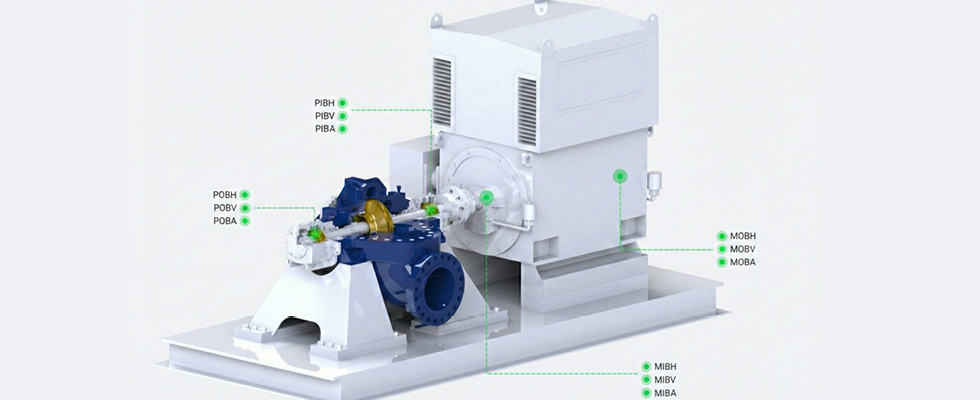
The end user partnered with an independent pump service provider to develop a wireless condition monitoring strategy that included wireless sensors, cloud-based analytical software and technical oversight from the service provider’s monitoring and diagnostic center. The subject unit was instrumented with four wireless triaxial accelerometers mounted on the bearing housings: pump inboard, pump outboard, motor inboard and motor outboard. Each sensor also measured surface temperature to provide additional operating context.
The sensors collected vibration data across multiple frequency ranges, including low-frequency velocity from 10 to 1,000 hertz (Hz), acceleration from 10 to 2,000 Hz and high-frequency acceleration up to 20 kilohertz (kHz) in the primary mounting direction. This bandwidth provided sufficient flexibility to adjust analytical focus based on machine behavior rather than relying on a single fixed maximum frequency.
Data collection followed a deliberately balanced strategy. A full time-waveform was captured once per hour, while overall vibration values were collected every five minutes. If an overall velocity measurement exceeded a predefined alarm threshold, an out-of-sequence waveform was triggered automatically. This avoided continuous high-density data streaming while remaining responsive to dynamic changes within the operating hour. Alarm events generated automated notifications to both the end user and the service provider’s analytical team, enabling timely assessment when conditions warranted.
Initial detection and symptom development
After several months of baseline monitoring, the pump outboard bearing began to show elevated vibration levels relative to the other bearing locations. All three measurement directions at the pump outboard bearing intermittently exceeded warning thresholds, with the vertical direction reaching a maximum velocity amplitude of approximately 0.37 inches per second (in/s) root mean square (RMS).
Velocity spectra for the pump outboard bearing showed a dominant running speed (1×) component with multiple harmonics, while time waveforms exhibited periodic impacts consistent with mechanical looseness. The pump inboard bearing showed similar spectral characteristics but at lower amplitudes, while both motor bearings remained within acceptable limits. This distribution suggested a localized issue within the pump rather than a driver-related problem or a system-wide excitation.
Sensor Installation Location
Narrowing the diagnostic field
Midstream pumps routinely experience variations in operating conditions that can influence vibration behavior. Changes in flow rate, suction pressure, fluid properties and proximity to best efficiency point (BEP) can introduce hydraulic excitation, including increased vane-pass response or elevated radial loading. These possibilities were evaluated using operating data, spectral content and phase relationships.
Phase analysis proved particularly valuable in narrowing the field of likely causes. The observed phase relationships were inconsistent with hydraulic instability, misalignment or structural resonance. Instead, the combination of dominant 1x harmonics, impact-rich waveforms and bearing-to-bearing amplitude relationships strongly favored a mechanical looseness mechanism. Among the remaining candidates, excessive thrust bearing end play emerged as the most probable root cause. Based on this analysis, the field recommendation was intentionally narrow: Inspect thrust bearing clearances at the pump outboard end and verify motor-pump alignment. This avoided a broad checklist of potential issues and focused maintenance effort where it was most likely to resolve the observed vibration behavior.
Maintenance findings and corrective action
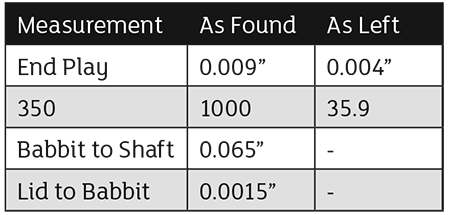
Field inspection confirmed the analytical diagnosis. Axial measurements taken at the thrust bearing showed excessive end play. As found, the end play measured 0.009 inches. After adjustment, the as-left measurement was reduced to 0.004 inches, bringing the clearance back within an acceptable operating range.
No significant wear or abnormalities were observed at the remaining bearing locations, and alignment verification was completed as part of the corrective work. Once maintenance was complete, the pump was returned to service under normal operating conditions.
Post-maintenance validation and feedback loop
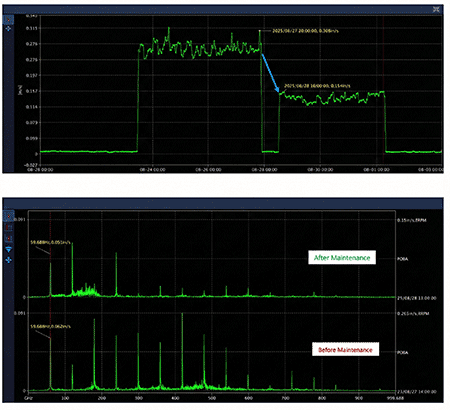
The effect of the corrective action was immediate and clearly reflected in the vibration data. Overall velocity at the pump outboard bearing dropped from approximately 0.37 in/s RMS to less than 0.20 in/s RMS, representing a reduction of roughly 50% and placing the vibration level well below the warning threshold. Acceleration levels at the same location decreased by approximately 70%, and the previously observed impact activity in the time waveform was substantially reduced.
Spectral data showed the disappearance of the harmonic structure that had characterized the pre-maintenance condition. Importantly, vibration levels at the pump inboard and motor bearings remained stable, reinforcing that the improvement was attributable to the thrust bearing correction rather than coincidental operating changes.
The ability to validate the corrective action almost immediately after the pump was returned to service provided confidence that the underlying mechanical issue had been resolved rather than merely mitigated. This rapid feedback loop is a key advantage of continuous monitoring, particularly in applications where unplanned downtime carries significant operational risk.
Reduction in Vibration After Maintenance
Applying the lesson across a fleet
Although this case centers on a single pump, the broader lesson extends across rotating equipment fleets. Wireless condition monitoring does not need to be positioned as an all-or-nothing digital transformation. When deployed with appropriate sensor placement, disciplined data collection strategies and experienced analysis, it becomes a practical tool for identifying and resolving common mechanical issues before they escalate.
Equally important is the role of domain expertise. The value in this case did not come from data volume alone, but from interpreting vibration behavior within the context of pump design, operating conditions and known failure modes. Reliability programs are most effective when monitoring systems are paired with subject matter expertise that understands not only individual assets, but the systems in which they operate.
By detecting abnormal vibration early, narrowing the diagnostic focus to a specific mechanical condition and validating corrective actions through immediate feedback, operators can reduce maintenance uncertainty and downtime risk. In midstream pumping systems, even modest mechanical corrections—such as thrust bearing end play adjustment—can yield outsized reliability gains when identified and addressed promptly.