


Stable pump performance depends on understanding how hydraulic loading, mechanical alignment and structural response change over time. A life cycle and system-wide approach provides the engineering reference points needed to maintain that understanding. This strategy defines operating envelopes, establishes commissioning baselines and applies trend analysis to detect shifts in system or machine behavior. It integrates design analysis, condition monitoring, diagnostics and risk-based maintenance into a single continuous process. Each new measurement is compared to baseline expectations. The result is a closed feedback loop that maintains controlled loading, predictable performance and long-term mechanical stability.
Why a Life Cycle Framework Matters
Pump behavior evolves as components wear—grout settles, supports relax, piping loads shift, duty cycles drift and fluid conditions change. Without a structured method for capturing and interpreting these changes, degradation processes can develop unnoticed until they progress into advanced failure modes.
A life cycle framework outlines how engineering parameters are established, monitored and updated over time. It specifies the baselines collected at commissioning, the sensor data required to detect deviation and the diagnostic methods used to verify mechanical or hydraulic causes. It guides design review, condition measurement, diagnostic evaluation and maintenance planning as elements of one unified technical process.
Start at Design: Establishing the Baseline
Long-term performance begins with correct hydraulic and mechanical fit. The pump curve must align with the system curve so operation stays near the best efficiency point (BEP), where hydraulic losses and radial forces are minimized. Operation outside this region increases vibration, temperature gains and energy intensity, accelerating wear across bearings, seals and hydraulic surfaces.
Design modeling should define static and dynamic head, friction factors, duty points and transient behavior. The operating envelope should identify preferred and allowable ranges, while avoiding zones based on stability and expected mechanical loading. Adequate net positive suction head (NPSH) margin must be established to prevent damaging cavitation and the pitting, imbalance and vibration signatures it produces. Mechanical design parameters such as grout quality, baseplate stiffness, anchor condition, pipe strain limits, shaft alignment tolerances and geometric stability should be documented at commissioning. These measurements become reference values for every future comparison.
Know the Condition: Measurement, Trend Analysis & Diagnostics
Continuous measurement is central to the life cycle approach. Vibration monitoring captures overall vibration levels and spectral content. Running speed peaks, vane pass frequencies, bearing tones and broadband energy levels indicate potential imbalance, misalignment, looseness, bearing degradation and hydraulic excitation. Aligning current data with commissioning baselines enables early detection of developing problems before alarm thresholds are reached.
Temperature and lubrication measurements add context by showing friction level changes and early signs of wear or contamination. Hydraulic performance data such as flow, suction and discharge pressure, differential head and power draw is compared against reference performance curves to detect internal wear, recirculation or system modifications.
When deviations appear, diagnostic tools reveal the underlying behavior. Modal analysis identifies natural frequencies and ensures separation from forcing frequencies. Operating deflection shape testing visualizes dynamic deformation in structures and machine interfaces that may indicate soft grout, base distortion or piping strain. Motion amplification video exposes small but meaningful structural movements in supports, fasteners and components. These diagnostics differentiate hydraulic, mechanical and structural drivers so corrective actions are accurate and effective.

Comprehensive Assessments: Connecting Condition, Cause & System Performance
Assessments extend beyond diagnostics by examining broader contributors to pump performance and reliability.
Root cause failure analysis (RCFA): RCFA provides a structured method for identifying the true underlying cause of a failure rather than only the immediate symptom. Structured techniques such as Five Whys, fault tree analysis and cause and effect diagrams help trace hydraulic, mechanical, operational or procedural contributors. RCFA prevents failures from repeating by identifying installation errors, operational drift or maintenance gaps that would otherwise remain hidden.
Physical inspections: Physical inspections provide confirmation and context that measurements alone cannot supply. Visual assessments of grout integrity, alignment condition, component wear, support structure condition and piping strain identify issues that affect stability and long-term behavior. These inspections validate or challenge the assumptions developed from vibration or hydraulic trends.
Energy assessments: Energy use is a powerful indicator of system health. As pumps drift from BEP due to wear or system changes, power consumption increases. Energy assessments evaluate pump efficiency, friction losses, duty cycle alignment, throttling losses and avoidable operating conditions. They help quantify performance deterioration and highlight opportunities for operational improvement.
Assessment integration: Diagnostics show the symptoms, assessments reveal the causes and trend analysis shows how quickly conditions are changing. When combined, these approaches provide a complete understanding of pump and system behavior. This supports corrective actions that are targeted, justified and scalable across facilities.
Act on Insight: Maintenance & Component Readiness
Maintenance execution should be driven by actual conditions rather than fixed schedules. Preventative work includes lubrication quality, alignment verification, balance checks, sealing system inspection, fastener torque verification, grout assessment and cleanliness. Predictive maintenance uses trend analysis and reliability tools to estimate remaining useful life for bearings, seals and couplings.
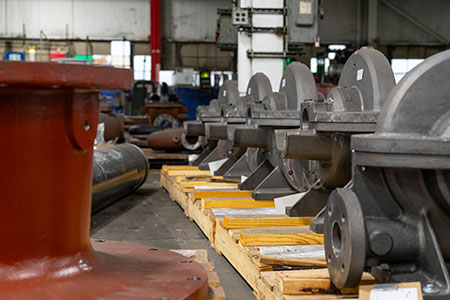
Plan for every part (PFEP) transforms spare parts management into a data-driven and proactive discipline. PFEP defines each part’s specifications, material composition, dimensions, storage location, packaging method, supplier information, usage rate and delivery expectations. It improves inventory accuracy by aligning stocking levels with real consumption patterns. PFEP minimizes shortages and excess inventory by ensuring that critical parts are available when needed and that long lead items are planned with sufficient time. It connects maintenance planning with procurement and supports reliability improvement by integrating condition-based data into spare parts strategy. For aging infrastructure, PFEP provides the structure required to manage the unique demands of legacy components with long manufacturing lead times.
Sustaining Stable Operation
Operations strongly influence reliability throughout the life cycle. Control logic should prevent deadheading, reverse flow, rapid cycling and extended low flow operation. Duty cycle analysis ensures that real operating points remain within preferred ranges.
Accurate documentation is essential for stability. Alignment measurements, vibration baselines, diagnostic reports, hydraulic test results and corrective actions should be captured in a structured system. Periodic hydraulic performance testing confirms that measured head and flow remain consistent with commissioning curves. Consistent deviation indicates developing hydraulic wear or system changes that require inspection.
Ongoing review of collected data supports long-term predictability. Vibration signatures, hydraulic deviation, alignment changes, bearing temperature trends and energy intensity should be evaluated regularly. If thresholds are exceeded, the response may include inspection, expanded monitoring or adjustments to operating envelopes and mechanical interfaces.
Life Cycle Reliability Checklist
- Establish design envelopes and classify system criticality.
- Build a life cycle model that considers hydraulic loading and expected degradation.
- Define mechanical and hydraulic boundaries such as BEP and NPSH margin.
- Instrument the system with sensors and inspection points that support baselines and trend analysis.
- Apply diagnostics and assessments whenever condition measurements show deviation.
- Perform preventative and predictive maintenance based on actual condition.
- Analyze reliability and degradation data and compare it to commissioning and design expectations.
- Update operating practices, design assumptions, monitoring routines, RCFA findings and PFEP strategies based on observed behavior.
Pump reliability depends on controlling hydraulic loading, mechanical alignment, structural support and system dynamics. A life cycle framework provides the engineering practices required to measure, interpret and correct these factors. When combined with comprehensive assessments such as RCFA, physical inspections and energy evaluations, and supported by PFEP-based component readiness, the framework creates a closed loop between design, monitoring, diagnostics, assessment and maintenance. Applied consistently, it enables stable, efficient and predictable pump performance over decades of service.
For more on preventative maintenance, visit pumpsandsystems.com/tags/preventative-maintenance.