


Plate and frame heat transfer is a technology that has been around for many decades and continues to be relevant in the heat transfer market, across multiple industries. It provides a high level of thermal efficiency along with flexibility and simplicity in its design, resulting in improved performance for a variety of applications, cost savings and reduced risk of downtime.
The use of gasketed plate and frame heat exchangers spans multiple industries and applications where liquid-to-liquid heat transfer is present. The gasketed plate and frame technology was originally developed in the 1920s, and it has transformed thermal management by providing greater heat transfer efficiency and ease of maintenance compared to other types of heat transfer not rooted in plate-type technology. It has become a go-to thermal technology for many common sectors such as heating, ventilation and air conditioning (HVAC), food retail and industry.
Structured for Efficiency
Plate and frame heat exchangers offer high thermal efficiency, making them useful in a variety of heat transfer applications. At the core of their efficiency is a design that employs a series of thin, corrugated plates (Image 1). These plates are arranged in a frame, creating multiple channels for fluids to flow through. These channels measure in mere millimeters, allowing a large number of plates to be stacked side by side. This arrangement maximizes the surface area for heat transfer while maintaining a compact footprint, enabling efficient thermal exchange between the fluids.
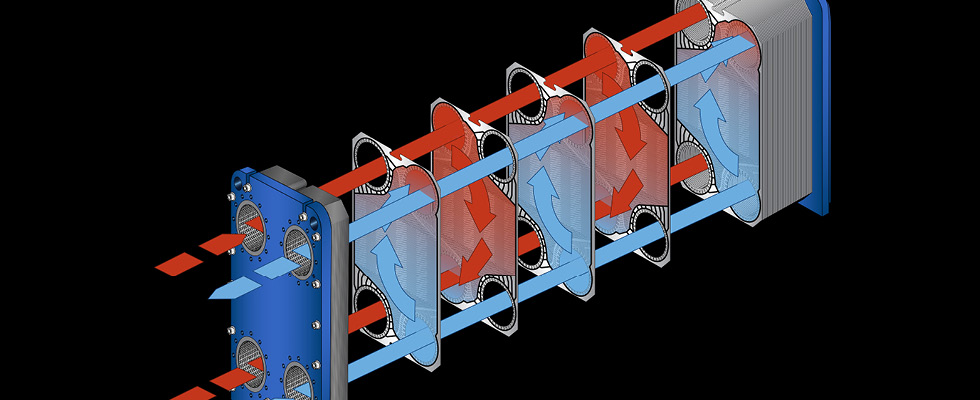
Corrugated plates induce turbulence even at low flow velocities, enhancing the heat transfer coefficient. As a result, the increased turbulence reduces the potential for fouling, which allows for extended maintenance-free operation.
Another aspect of the efficiency of plate and frame heat exchangers is their compact size, which minimizes the amount of material required for construction, thus lowering the initial investment. Furthermore, the compact design contributes to lower fluid holdup requirement within the system (glycol usage, for example), enhancing the environmental benefit. In the case of the semiwelded design, used in refrigeration applications, less ammonia charge is required than in a traditional refrigeration system.
Key Applications
One key application where plate and frame heat exchangers provide a big impact is free cooling. It is an environmentally friendly way to produce chilled water without the use of electricity-intensive or refrigerant-based mechanical cooling. Wide use of free cooling can be found in air conditioning and other process cooling applications. It is implemented when the cooling source is at a lower temperature than the desired temperature of the process cooling media (typically during spring, fall and winter seasons). Air is a widely used cooling source; however, groundwater, rivers and lakes can serve as an alternate source.
Heat recovery is another application where this technology plays a big role. As the reduction in carbon footprint continues to be the primary goal for the foreseeable future, heat exchangers are an integral part in this effort. Recovering heat from any process where it would otherwise be discarded into the surrounding environment allows users to tap into a resource that provides energy savings and reduction of emissions.
Future-Proofing Through Flexibility
The flexibility of plate and frame heat exchangers caters to the dynamic needs of various industries. Since the corrugated plates are pressed from a thin continuous coil, they can be arranged into various sizes. Taller/longer plates allow for longer bed time with the heat transfer fluid, which enables the plates to excel in heat transfer applications where a large temperature drop is desired.
Shorter plates cater to applications with height and pressure drop limitations and can be arranged in a multipass configuration, allowing for a longer bed time. As a result, plate and frame heat exchangers can achieve high thermal performance with relatively small temperature differences between the hot and cold fluids, reducing energy consumption and operational costs.
Furthermore, their modular nature and versatile plate design allows for easy customization and scalability across various applications. To meet operational needs, these heat exchangers can be equipped with various plate designs (Image 2). Additional plates can be added to the existing setup to increase capacity or to accommodate changes in process requirements. This adaptability ensures that the heat exchanger can grow with the process needs.
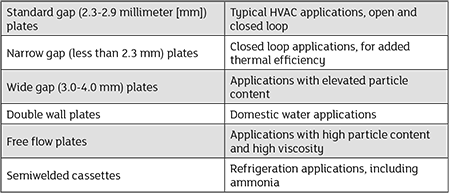
Plate and frame heat exchangers can be constructed from a wide range of materials, including stainless steel, titanium and various other alloys to handle different types of fluids and operating conditions. This versatility makes them suitable for applications across sectors such as HVAC, food, beverage processing, pharmaceuticals, chemical manufacturing and power generation.
Maintenance-Friendly Design
Ease of maintenance is another benefit of plate and frame heat exchangers. These exchangers are designed for straightforward maintenance in that the plates can be easily accessed by loosening the bolts on the frame and sliding the plates apart.
This accessibility allows for quick inspection, cleaning and replacement of individual plates if necessary. The gasketed design further simplifies maintenance, as gaskets can be replaced without glue or the need for specialized tools. The heat exchanger can be cleaned without any disassembly using a backflush valve.
Another benefit of plate and frame heat exchangers is their durability and longevity. The materials and various plate designs used in their construction offer resistance to corrosion, fouling and wear to ensure they can withstand harsh operating conditions over extended periods of time. This durability reduces the frequency and cost of replacements, contributing to long-term operational savings. Moreover, the efficient design and ease of maintenance mean they can maintain their performance over time, providing consistent and reliable service to the user.