

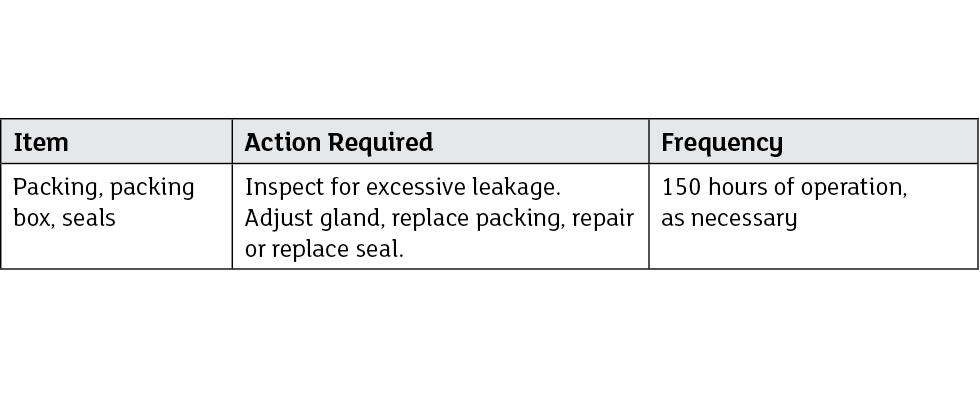
Preventative maintenance involves replacing or repairing something on a time-based interval. For example, greased bearings may require regreasing based on the number of operating hours. Preventative maintenance recommendations are generally provided by the pump manufacturer in the Installation, Operation and Maintenance (IOM) manual, and the Hydraulic Institute (HI) covers general preventative maintenance recommendations for rotodynamic pumps in American National Standards Institute (ANSI)/HI 14.4 Rotodynamic Pumps Manuals for Installation, Operation and Maintenance. Image 1 is an excerpt from the preventative maintenance guide in ANSI/HI 14.4. Note that the action required is on a time basis.
Predictive maintenance occurs as part of a condition monitoring program. It requires gathering data and analyzing it to determine when a part or component should be replaced or repaired. The data gathering may be on a time basis, but the action taken is not based on a set operating time interval, which makes it different than preventative maintenance. Utilizing predictive maintenance can extend run times between repairs or identify failure modes in advance of the failure occurring, which can limit unexpected failures and downtime. The most common predictive maintenance item for pumps is the periodic gathering of vibration data on the bearing housing to determine the health of rolling element bearings. An analysist will evaluate the data and may generally group the health into four stages of failure, with a goal of identifying the early stages of failure (stage 1), tracking the failure progression and scheduling replacement before severe damage (stage 4) has occurred.