


Most reliability teams are not starving for data. In just about every plant, there are vibration sensors, power monitors, thermal cameras, the distributed control system (DCS)—an abundance of systems providing alerts. Thousands of them, every month. But when it is time to actually make a decision, things can get messy. People argue, decisions drag on and sometimes nobody can really explain why they chose one path over another.
The problem is usually not, “Hey, let’s bolt on a few more sensors.” It is that the information is scattered across too many tools. Each system knows its own piece, so now engineers have to play detective, digging through different dashboards and lining up timelines, just to answer the simplest question: What does this alarm even mean?
Alarms by themselves do not give the whole picture. For real confidence in decisions, it is important to see the full story across all the angles that matter for pumps and motors.
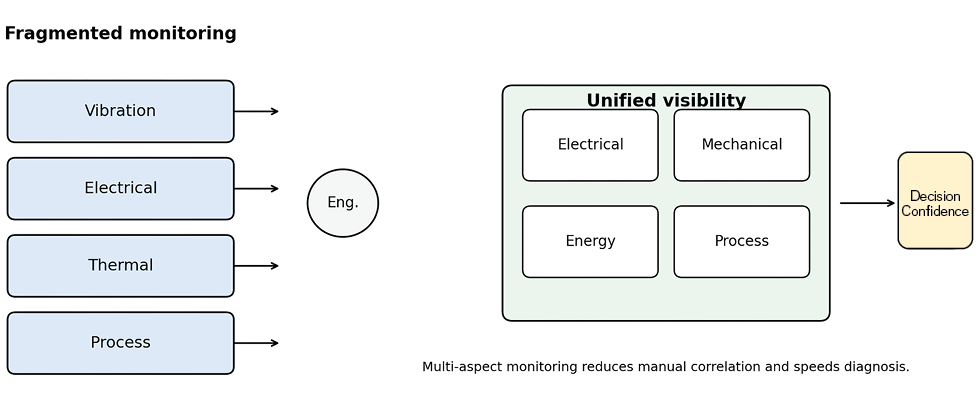
Why “More Data” Has Not Fixed Decisions
Most of the tech out there is set up to watch just one slice of the pie:
- Vibration monitors catch the mechanical motion.
- Electrical monitors watch current and voltage.
- Thermal imaging shows surface temperature shifts.
- The DCS tracks process stuff flow, pressure and load.
All of this helps, but in the real world, pump and motor failures do not stick to one lane. Mechanical problems show up in electrical signals. Electrical faults mess with energy use. Process hiccups can make vibration data look strange. If these things are kept separated, engineers end up piecing the story together by hand every single time.
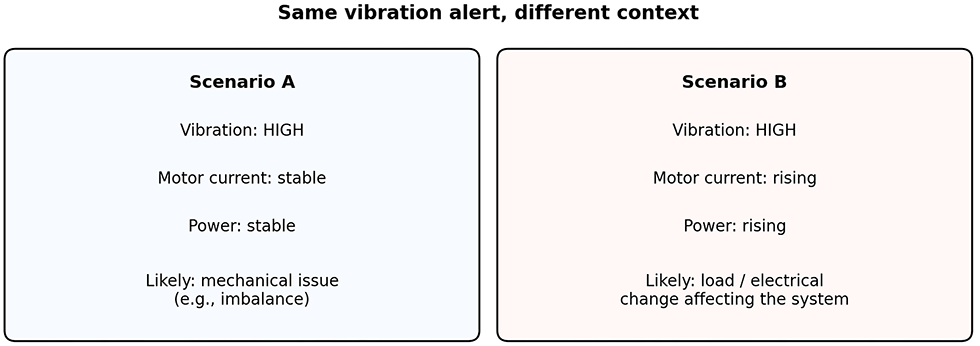
Think about what happens when a vibration alarm goes off. Suddenly, there are a dozen questions:
- Is the motor current creeping up?
- Did efficiency just drop?
- Did the load change, or did operations tweak something?
- Are other, similar assets seeing the same thing?
The answers are scattered across different systems, each with its own format and time stamp. It is no surprise responses slow down and uncertainty climbs.
The Limitations of Alarm‑Centric Monitoring
Thresholds have their place. They are needed. But an alarm does not tell why something changed—just that it did.
Take a pump with high vibration:
- If the motor current is steady and the load has not changed, often it is thought to be a mechanical issue—maybe an imbalance.
- If the current is rising but the process demand is flat, that points to something else entirely.
With only vibration data, those two situations look almost the same. Without the bigger context, the same alarm can send a user in totally different directions and lead to completely different maintenance plans. That is why, even with more alarms than ever, decision confidence is not budging.
Why Automation Is Not a Magic Fix
There is no shortage of software promising automated recommendations. Sure, it sounds slick, but seasoned reliability
teams know better. Every plant is different—design, how it runs, how much risk it accepts and what “good enough” even means. Engineers on the ground know those wrinkles better than any canned algorithm. Take their judgment out, and it is just a case of swapping one set of uncertainties for another. The point is not to replace people. It is to arm them with a clear, complete view so they can move faster, explain their thinking and actually trust the calls they make.
What the Full Picture Really Looks Like
In order to gain real confidence, it is important to see four things, together:
- Electrical health: Electrical measurements see fault that cannot be seen any other way—winding stress, rotor problems and power quality issues. A lot of the time, electrical problems show up before anything mechanical can be seen.
- Mechanical behavior: Changes in the motor’s electrical signature can reveal what is happening in the whole system—imbalances, misalignment, bearing issues or how the pump or compressor is behaving. It is a system-level view, not just a point sensor.
- Energy and efficiency: What is this really costing? Watching power trends, efficiency drops and power factor offers a second opinion so it is possible to double-check or challenge information being received from other sources.
- Process context: It is vital to know how the plant is running—load swings, shifts from normal to abnormal and how baselines drift. Otherwise, it is possible to end up chasing false alarms that are just part of normal ops.
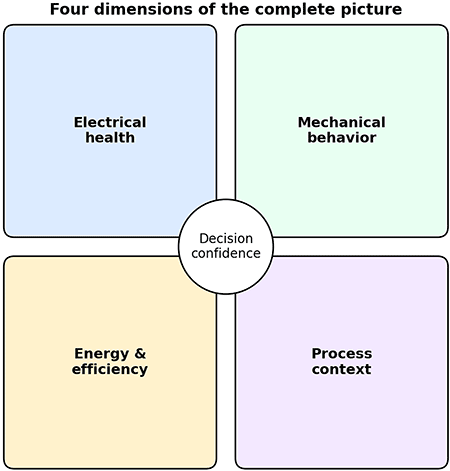
Considering all four of these at the same time allows staff to stop chasing symptoms and start seeing real explanations.
What Changes in Practice
What does this change day to day? In the old world, teams had to juggle several systems, pile on installations and piece together data by hand, and analysts carried a heavy load. It was messy. Now, with this kind of multilayered view, everything is in one place. Context makes sense. Problems can be spotted faster. It is a lot easier to stand by decisions when in the room with operations or leadership.