

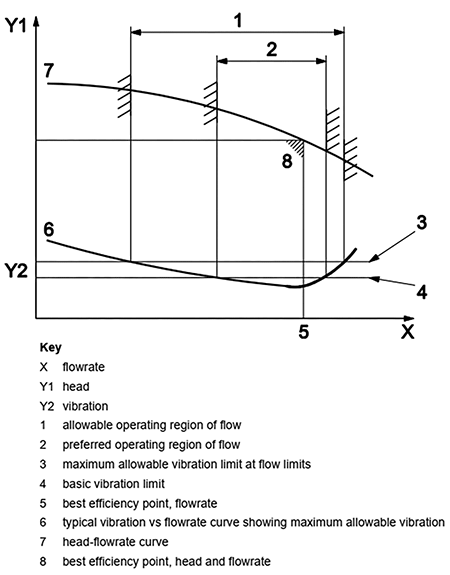
The preferred operating region (POR) is understood to be the specific flow range where a pump operates most efficiently and reliably, typically centered around the best efficiency point (BEP). Similarly, the allowable operating region (AOR) is the flow range where the pump can function acceptably over its expected lifetime, also around the BEP, although with a wider spread.
Rated flow—i.e., the nominal flow specified on the pump data sheet—should be quite close to the BEP of the pump to be purchased. During the first stages of the pump selection procedure, the owner usually has to make choices based on the manufacturer’s family performance charts.
This article is aimed at explaining the meaning of the above terms in regard to the information given by the manufacturer’s family performance charts. Users can learn why it is important to select a pump within the specified flow rate limits. They will also find a simple and practical method of constructing the rated flow rate area of a pump based on the manufacturer’s performance curves.
What Do ANSI/HI Standards Specify?
According to American National Standards Institute/Hydraulic Institute (ANSI/HI) 9.6.3-2012 – Rotodynamic (Centrifugal and Vertical) Pumps – Guideline for Allowable Operating Region, POR and AOR are defined as follows:
For POR (§ 9.6.3.1): “POR is a range of rates of flow to either side of BEP within which the hydraulic efficiency of the pump, if not degraded ... ensures higher reliability and lower energy consumption.” For most rotodynamic pumps, POR is between 70% and 120% of BEP. For specific speeds greater than 4,500 (U.S. customary), POR is between 80% and 120% of the BEP.
For AOR (§ 9.6.3.2): “A wider range of flow ... over which the service life of a pump is acceptable ... should be defined with the help of the pump manufacturer.”
What Do API Standards Specify?
American Petroleum Institute (API) Standard 610 – Centrifugal Pumps for Petroleum, Petrochemical and Natural Gas Industries, 12th ed. – 2021 defines POR and AOR as follows:
For POR (§ 6.1.16): “Pumps shall have a POR of 70% to 120% of BEP flow rate of the pump as furnished.” In addition (§ 6.9.4.6), for up to 3,600 rotations per minute (rpm) and 400 horsepower (hp):
- Overall vibration velocity (Vu) < 0.12 inches per second (in/s) root mean square (RMS)
- Discrete frequency vibration velocity (Vf) < 0.08 in/s RMS
For AOR (§ 3.1.1): “[A] portion of the pump’s hydraulic coverage over which the pump is allowed to operate, based on vibration within the upper limit of this standard or temperature rise or other limitation, specified by the manufacturer.” Also (§ 6.9.4.1), “The AOR shall be stated in the proposal. If the AOR is limited by any other factor than vibration, that factor shall also be stated in the proposal.” In addition (§ 6.9.4.6), for up to 3,600 rpm and 400 hp:
- Vu < 0.12 + 30% = 0.156 in/s RMS
- Vf < 0.08 + 30% = 0.104 in/s RMS
Additionally—and very importantly—API (§ 6.1.16), introduces:
- Rated flow, i.e., the nominal flow rate specified on the pump data sheet by the purchaser, which is specified to be “within the region of 80% to 110% of the BEP flow rate”
- The end of curve flow, which is defined as 120% of the BEP flow rate
Note that ANSI/HI and API agree that POR should be between 70% and 120% of BEP, but API additionally requires vibration to be within certain limits. For AOR, while ANSI/HI accepts the manufacturer’s input for its definition, API also requires vibration within certain limits (POR limits + 30%). In addition, API requires rated flow within the region of 80% to 110% of the BEP and end of curve flow at 120%.
ANSI/HI does not specify how close to the BEP of the pump the rated flow sought should be specified to be, as API does. However, both specify that POR should be between 70% and 120%.
It would, therefore, be reasonable to claim that, not only for API pumps, but for ANSI/HI pump selection as well, it would be a good practice for the rated flow rate to be between 80% and 110% of BEP flow rate.
Usual Manufacturer Family Performance Charts
During the preliminary selection stage, the owner’s engineer is faced with the performance charts published in the technical literature.
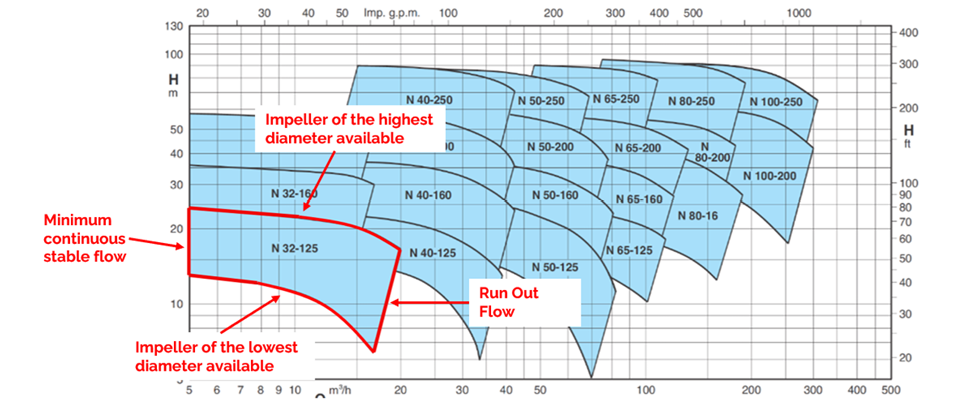
A typical manufacturer’s family performance chart is shown in Image 2. Note that in each region:
- The left side is the minimum continuous stable flow
- The right side is the run out flow
- The upper curve is the performance curve of the impeller of the highest diameter available
- The bottom curve is the performance curve of the impeller of the lowest diameter available
The areas shown are the allowable operating regions, as defined by the manufacturer. They are not the areas where the rated flow should lie.
For more on pump selection, visit pumpsandsystems.com/tags/pump-selection.