


Pumps are the quiet workhorses of commercial hydronic heating, ventilation and air conditioning (HVAC) systems. They move chilled and heated water through distribution loops, heat exchangers and terminal equipment, maintaining flow, pressure and temperature across sprawling commercial buildings. However, that “quiet” part can turn noisy and troublesome when things go wrong. Leaky seals, bearing failures, noisy pump hammering, failed sensors or a variable frequency drive (VFD) that has been overridden to “hand” mode can all disrupt performance and increase maintenance needs.
Smart pumps build on conventional designs to address many of these operational challenges. A smart pump integrates a high-efficiency pump, motor and embedded variable-speed control into a single, factory-engineered package. The result is a compact, self-optimizing system that simplifies installation, improves reliability and keeps those quiet workhorses running smoothly behind the scenes.
Beyond integration, smart pumps add long overdue control capabilities to hydronic HVAC systems. Smart pumps have mapped performance curves that correlate motor signals (speed and torque) with hydraulic performance. By embedding these correlations, the pump controller can infer flow and head in real time, enabling manufacturer-optimized control strategies that improve overall system efficiency and potentially eliminate the need for downstream sensors.
Contrast this with traditional assemblies which can include remote pressure sensors that drift or fail, control-loop tuning that never quite converges, communication hiccups between building automation system (BAS) and VFD, misalignment after rigging and field wiring that introduces noise or faults. Each element is manageable, but the stack creates many potential failure points, especially when multiple contractors are responsible for discrete components. Smart pumps are purpose-built to alleviate failure points and incorrect assembly, ensuring consistent and reliable performance.
Energy Benefits: More Than Just Variable Speed
At their core, smart pumps still follow the same physics that make variable-speed control so effective. Like conventional VFD-controlled systems, they modulate speed to match real-time demand. Because pump power scales with the cube of speed, even small reductions in speed can yield substantial energy savings. For example, a pump operating at 70% of design flow uses roughly half the power of a throttled constant-speed pump. By enabling right-sizing and speed trimming, rather than throttling through valves, smart pumps also mitigate oversizing penalties in constant-load applications.
The real benefit lies in persistent performance. Smart pumps help maintain performance over time through several design features. Embedded performance mapping eliminates the need for external differential pressure sensors, removing a potential source of drift and failure. Factory-configured control modes reduce reliance on custom VFD programming and make it easier to restore proven settings after service events. And because smart pumps enforce safe operating limits internally, operators are less likely to bypass controls to resolve comfort issues. Together, these features can help ensure that energy savings persist long after installation.
Independent evaluations have shown how critical these design features are. A Massachusetts impact evaluation of VFD installations found that missing controls or misconfigured speeds sharply reduced energy savings, while a Connecticut Energy Efficiency Board study reported VFD energy savings of only 54% of original engineering modeling estimates. Studies like these underscore the importance of well-commissioned, self-regulating systems, which is precisely where smart pumps can provide a measurable advantage.
Benefits That Matter to Operations
The same features that protect long-term energy savings also simplify life for those who design, install and operate hydronic systems.
- Simplified installation: Smart pumps arrive with preprogrammed templates and guided setup. Self-adjusting control features shorten balancing time, and digital interfaces (local human machine interfaces [HMIs] or mobile apps) reduce the “black box” feel. Less time and more confidence in installation translates directly to lower upfront cost and fewer callbacks.
- Operational improvements: Integrated designs reduce the component count and interfaces that can fail. Additionally, less throttling means lower risk of off-curve operation and less wear on equipment.
- Occupant comfort and performance: Stable differential pressure and predictable flow improve coil control. That yields tighter temperature control at the zone level, fewer hot/cold complaints and more consistent dehumidification in cooling seasons. Occupants usually notice when comfort is off, but they rarely notice when the hydronics work well—which is the point.
The Building Sector Is Taking Notice
As the benefits become clearer, adoption is growing. Multiple forces are converging to drive greater attention to high-performance pumping solutions: policy, economics and technology.
Building performance standards, updated energy codes and federal efficiency regulations are tightening expectations for both whole-building and component-level performance. At the same time, ongoing energy price volatility is pushing building owners to seek controllable, equipment-based energy savings.
Meanwhile, technology maturity is lowering barriers to adoption. Smart pump solutions are now widely available, and facility teams are increasingly familiar with integrated controls and BAS connectivity. Utility efficiency programs are also accelerating this shift by addressing first-cost barriers and information gaps. Midstream incentives, such as the Extended Motor Products program from the Northwest Energy Efficiency Alliance (NEEA), are helping make smart pumps standard practice. Industry organizations like the Hydraulic Institute are reinforcing this trend by providing comprehensive technical and utility program resources on pump efficiency and system optimization.
Barriers remain, such as perceived complexity and cost as well as unfamiliarity among some contractors. The reality is that smart pumps are often cost-comparable to standard VFD-driven pumps, and that is before installation and commissioning cost savings. While smart pumps can reduce complexity at the system level, success still depends on good application engineering and commissioning. Clear guides, training and templates are closing that gap.
Case Study: Right-Sizing for Results in a 20-Story Office
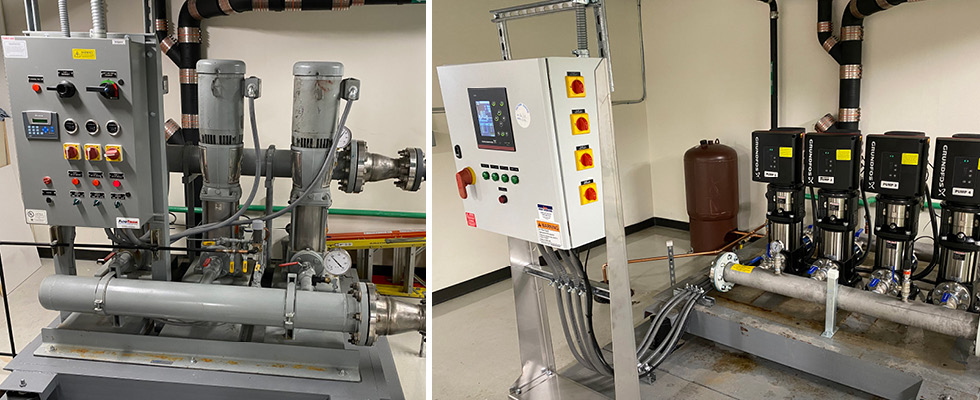
A 20-story office building in Bellevue, Washington, struggled with chronic noise, vibration and maintenance issues from three 20-horsepower (hp) distribution pumps operating in simple on/off control. The retrofit replaced this oversized trio with four 5-hp electronically commutated motor (ECM) smart pumps, each with built-in variable-speed control.
Beyond the control upgrade, the key improvement was right-sizing. Distributing capacity across multiple smaller pumps increased turndown capability, improved redundancy and kept operation closer to the pumps’ best efficiency point throughout the year. The result was an 87% reduction in pump energy use, along with quieter operation and lower maintenance demands.
No two buildings are identical, and savings will always vary by load profile, control sequence and application. Yet across a growing number of field installations, the directional outcome has been consistent: less energy, less noise and fewer headaches. Smart pumps are more than another line item on an energy audit. By integrating high-efficiency motors, variable speed control and embedded intelligence, they simplify installation, stabilize operation and protect savings over time. They also make life easier for the people who keep buildings comfortable.
With increased energy costs in play and proven technology at hand, the case for smart pumps is clear. Start with thoughtful application engineering, right-size instead of oversize, leverage integrated control modes and document a straightforward commissioning sequence. The smart pump will take care of the rest.
References
- KEMA, Inc., and DMI, Inc. Impact Evaluation of 2011–2012 Prescriptive VSDs. May 9, 2013. eec.ri.gov/wp-content/uploads/2018/03/kema_2013_prescriptive_vsd_report.pdf
- Connecticut Energy Efficiency Board Evaluation Committee. Evaluation Studies and Results Abstracts for 2018: A Report to the Energy and Technology Committee of the Connecticut General Assembly. January 2020. energizect.com/eeb-evaluation-reports-and-studies
For more on HVAC, visit pumpsandsystems.com/tags/hvac.