
![IMAGE 1: Proper arc-rated PPE can mean the difference between survivable injury and fatal trauma (Image courtesy of National Safety Apparel [NSA])](/sites/default/files/styles/library_teaser_image/public/2026-02/OT_Motion_IMG1_0326.jpg.webp?itok=25PMzfJa)


Electricity is one of the most essential utilities in modern industry—and one of the most dangerous when not properly managed. Among all electrical hazards, arc flash incidents remain one of the most destructive, misunderstood and life-altering events facing workers in manufacturing, utilities, construction and industrial maintenance.
While shock hazards are often top of mind, arc flash events can cause catastrophic injuries in a fraction of a second, often without warning.
Survivors frequently face multiple surgeries, long-term disability, post-traumatic stress disorder (PTSD), extended time away from work and permanent lifestyle changes. The human impact of an arc flash injury lasts far beyond the incident itself.
For these reasons, it is vital to develop and maintain a deep understanding of this high-risk area in workplace safety. This article will explain what an arc flash is, why it happens, who is at risk and most importantly, how arc flash and related disastrous incidents can be prevented.
What Is an Arc Flash?
An arc flash is a sudden release of electrical energy through the air between two energized conductors. This uncontrolled electrical discharge can generate temperatures exceeding 35,000 F (almost four times as hot as the surface of the sun at 9,932 F), a powerful pressure wave or blast, blinding light, intense ultraviolet (UV) radiation and molten metal and shrapnel expelled at high velocity.
Unlike electric shock, which requires physical contact, an arc flash can occur without direct contact with energized parts. The result is often severe burns, hearing loss, limb loss, blindness and—in many cases—fatalities.
![IMAGE 1: Proper arc-rated PPE can mean the difference between survivable injury and fatal trauma (Image courtesy of National Safety Apparel [NSA])](/sites/default/files/15321/OT_Motion_IMG1_0326.jpg)
How Arc Flash Incidents Occur
Arc flash incidents typically result from:
• Equipment failure due to aging, corrosion, contamination or improper installation
• Human error, including dropped tools, incorrect testing procedures or bypassed safety systems
• Improper maintenance
• Loose connections or failed insulation
• Overvoltage, short circuits or ground faults
Arc flash events are most commonly associated with working on or near switchgear, motor control centers, panelboards, transformers, disconnects, breakers and industrial control cabinets.
Even routine tasks, such as voltage testing, breaker racking or inspection inside energized enclosure, can trigger an arc flash if proper precautions are not taken.
The Physics Behind the Danger
The dangers of an arc flash are numerous. Skin exposed to arc flash heat can instantly suffer third-degree burns. The arc blast can exceed 2,000 pounds per square foot, making it capable of throwing a worker across a room. Sound levels over 140 decibels (dB) can rupture eardrums. Intense light can cause permanent eye damage, even through closed eyelids or noncompliant eyewear. Copper expands up to 67,000 times its solid volume when vaporized, becoming deadly shrapnel.
Who Is at Risk?
Arc flash hazards affect far more people than many realize. High-risk groups include maintenance and reliability technicians, electricians and electrical engineers, instrumentation and controls technicians, operations and production workers, contractors and temporary workers, and facility engineers and plant managers. Even nonelectrical workers can be at risk when near energized equipment during troubleshooting, startup or shutdown activities.
Standards & Regulations
Several industry standards define arc flash safety practices in the United States, including National Fire Protection Association (NFPA) 70E, Occupational Safety and Health Administration (OSHA) regulations for General Industry and Construction, and Institute of Electrical and Electronics Engineers (IEEE) 1584. These standards require employers to perform arc flash risk assessments, label equipment with hazard warnings, provide appropriate personal protective equipment (PPE), implement safe work practices and offer documented training. Failure to comply with these standards can result in serious injuries, regulatory fines, civil liability and criminal penalties.
Arc Flash Boundary & Hazard Categories
The arc flash boundary is the minimum distance from a potential arc source where a worker could receive a second-degree burn if unprotected. This boundary is determined by the system’s available fault current and clearing time.
Arc flash boundaries are a required, permanent element on the source’s label. Sometimes, facilities mark arc flash boundaries using methods like floor tape (yellow caution tape) and wall signs or labels. However, these are often temporary and set up only when work is being performed, because the boundary distance may change and is not always present.
NFPA 70E classifies PPE requirements into hazard categories or by incident energy analysis measured in calories per square centimeter (cal/cm²). Each category requires increasing levels of flame-resistant clothing and protective equipment.
Certain manufacturers offer extensive arc flash training and safety services focused on NFPA 70E compliance. Options include awareness (nonqualified class), qualified-persons training (required for those who work on equipment) and refresher courses.
Personal Protective Equipment
Proper PPE does not eliminate the hazard but dramatically reduces the severity of injury during an arc event. A worker should be covered head to toe when in a high-risk area. Arc flash PPE includes flame-resistant clothing, arc-rated face shields and hoods, voltage-rated gloves with leather protectors, hard hats, hearing protection and dielectric safety footwear.
All PPE must be properly rated for the incident energy level, inspected before use, maintained in good condition and worn correctly at all times within the arc flash boundary. Arc flash boundaries and hazard categories determine the types of protective equipment required for safe work. For example, natural leather is often used in arc flash protective footwear because, unlike synthetic materials, it resists melting and burning. Heavy-duty leather is required for Hazard/Risk Categories (HRC) 2 and above or when incident energy transcends 4 cal/cm2.
Preventing Arc Flash Incidents
Arc flash prevention is rooted in engineering controls, administrative controls and human behavior. In addition to PPE usage, the most effective strategies include proper labeling/signage, de-energizing equipment whenever possible, performing routine arc flash studies, maintaining electrical equipment, establishing safe work practices and conducting regular training.
Each of these strategies is a single protection step that will not be enough by itself but will be much more effective when combined into a carefully considered safety plan.
Labeling
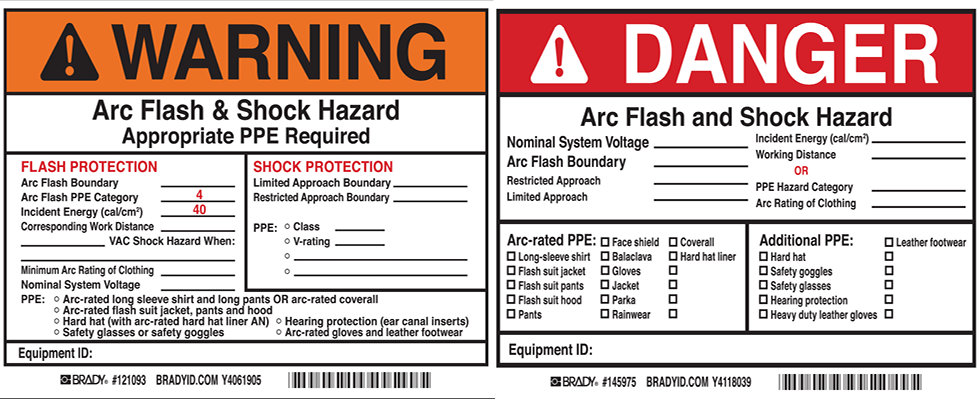
The first line of defense is arc flash warning labels, which are required on most energized equipment in regulated facilities.
These labels display nominal system voltage, arc flash boundary distance, incident energy level, required PPE category and shock hazard boundaries. These labels are critical for prejob planning and should never be ignored, covered or removed without reevaluation.
Safe energizing and de-energizing of equipment
One of the most critical moments for arc flash risk occurs during the energizing or reenergizing of electrical equipment. Energizing equipment introduces the highest likelihood of a fault due to loose connections, insulation failure, incorrect installation or human error. Whenever possible, equipment should be fully de-energized before inspection, testing or maintenance, following proper lockout/tagout (LOTO) procedures.
When energized work is unavoidable, it must be formally justified, approved and performed using documented energized work permits. Employees should stand to the side of equipment when energizing, use remote racking or switching tools where available and wear arc-rated PPE appropriate for the calculated incident energy.
Even routine actions such as closing breakers or operating disconnects should be treated as high-risk when performed on energized systems.
Maintaining electrical equipment to reduce risk
Poorly maintained electrical equipment is a leading contributor to arc flash incidents. Dust, moisture, corrosion, aging insulation and loose or damaged components increase the likelihood of an arc fault. A proactive electrical maintenance program is essential and should include regular inspections, infrared thermography, torque verification, cleaning and testing of protective devices. Breakers, relays and fuses must be properly rated, calibrated and maintained to ensure they operate within their designed clearing times. Equipment labels should be kept up to date to reflect current system configurations and available fault current.
Simply put, well-maintained equipment improves reliability and dramatically lowers arc flash risk by reducing failure points that can trigger catastrophic events.
Creating a plan and training employees
Preventing arc flash incidents requires more than equipment and PPE—it demands a structured plan and continuous training. Employers should develop and maintain an arc flash safety program aligned with NFPA 70E that clearly defines roles, responsibilities, procedures and safe work practices. This includes performing arc flash risk assessments, establishing boundaries, standardizing work procedures and documenting emergency response actions.
When it comes to training, employees must understand arc flash hazards, how to interpret equipment labels, how to select proper PPE and when energized work is prohibited. Regular refresher training reinforces safe behaviors and ensures compliance as systems, personnel and regulations evolve. A strong safety culture, supported by leadership and ongoing education, is one of the most effective tools for preventing arc flash incidents.
A facility may lack in-house safety specialists and could benefit from qualified third-party experts, either to help with planning or training or just to provide a second opinion on a new or existing program.
As facilities adopt higher fault-current systems, integrate renewable energy, build data centers and develop electric vehicle infrastructure, arc flash risk continues to increase. This makes committing to training, labeling, maintenance and management more critical than ever.
Arc flash is one of the most dangerous workplace electrical hazards. It can cause fatal burns, explosions and permanent life-altering injuries. PPE saves lives, but eliminating the risk is always the first choice.
Practicing arc flash safety is not just about compliance. Reading every label thoroughly, performing every lockout procedure correctly and following all guidelines are deliberate choices to protect life.