

Mining sits at the very core of the global economy, supplying the raw materials that power infrastructure, manufacturing, energy production and modern technology.
Today, the mining sector represents approximately 6%-7% of global gross domestic product (GDP)—meaning that roughly six to seven cents of every dollar generated worldwide is tied to mining activity. Valued at approximately $2.1 trillion in 2023, the global mining market continues to expand as demand for critical minerals, metals and resources accelerates.
Industry forecasts project the sector could reach $2.8 trillion by 2028 and grow to nearly $3.7 trillion by 2033, reflecting mining’s essential role in supporting economic growth, energy transition initiatives and industrial development worldwide. Behind this vast and evolving industry is a network of technologies that keep operations moving efficiently and safely—and among the most essential are pumps.
Essential Pump Functions in Mining
Pumps play a vital role in supporting nearly every stage of mining operations, helping move the materials and fluids that keep processes running efficiently and safely. They are used to transfer slurries and process fluids, handle aggressive chemicals in mineral extraction, support material transport and maintain environmental controls throughout the site.
There are two types of pumps that are most commonly used in mining: mag-drive centrifugal pumps and air-operated double-diaphragm (AODD) pumps. As a rule, chemical centrifugal pumps are primarily used for above-ground mining and mineral excavation, including copper, gold and lithium operations.
In addition to processes such as leaching and smelting, acid mining treatment, reagent circulation, separation and refinement, and sintering, centrifugal pumps are highly capable of handling the corrosive chemicals commonly associated with mining, like hydrochloric acid, caustic soda, sulfuric acid and more.
Alternatively, in below-ground mining applications—particularly in dewatering—water management becomes a critical operational priority, and AODD pumps are often used in these cases.
Dewatering in mining is the process of removing excess water from a mine site so operations can be conducted safely, efficiently and economically. By controlling water accumulation, dewatering keeps mining areas dry enough for work to proceed without risking personnel safety or damaging equipment and infrastructure. It also plays an important role in environmental responsibility by managing water discharge and reducing the potential impact on surrounding ecosystems.
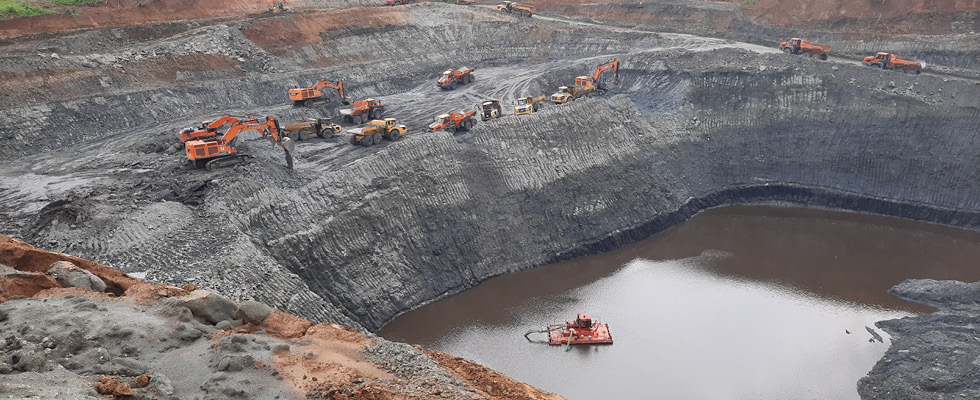
Mining environments present several inherent challenges that make effective water management necessary, including groundwater intrusion, abrasive slurries, high solids content in fluids and corrosive process liquids.
Pumps play a central role in dewatering in a wide variety of ways, the most obvious of which is water removal. By continuously removing groundwater seepage and rainwater from mining areas, pumps keep the mine dry. This prevents flooding and reduces safety hazards such as slippery surfaces or submerged electrical equipment, helping create a safer working environment for personnel.
Additionally, excess water can obstruct the mining process by making it difficult to access ore deposits or operate machinery. Pumps ensure mining operations are carried out smoothly by removing water from excavation sites and keeping equipment functioning without interruption, thereby reducing downtime and maintaining productivity.
Pumps also play an important role in managing the treatment and disposal of water collected during dewatering, helping mining operations control contaminants and minimize environmental impact on surrounding ecosystems.
For these demanding dewatering applications where reliability and durability are critical, AODD pumps can provide many benefits.
Meeting Dewatering Demands With AODD Pumps
As an air-driven positive displacement pump, AODD pumps displace fluid at one end while suction occurs at the opposite end. This reciprocating style differs from centrifugal pumps, which move fluid by the rotational energy created by driven rotors (impellers). The other main differentiator is the type of substances the pumps can transfer. With AODD pumps, it is possible to pump suspended solids, whereas this can be limited with centrifugal pumps.
This is particularly key when it comes to mining dewatering, as the water at mine sites often contain sludge, suspended solids, debris, tailings and slurries. The different size diaphragm and valve options allow pump operators to adjust according to these particle sizes, allowing large solids to pass without clogging.
AODD pumps are highly reliable in the harsh conditions typical of mining environments. In dewatering applications, water levels frequently fluctuate, creating variable suction lift, changing discharge pressures and intermittent operating conditions. The self-priming design of AODD pumps allows them to adapt to these changes with consistent performance. They can also lift water from significant depths—typically up to 20-25 feet on the suction side—making them well suited for applications where the pump is not submerged.
Additionally, AODD pumps can run dry without sustaining damage, allowing them to continue operating safely even when the liquid source is temporarily depleted. This capability reduces downtime, minimizes maintenance and eliminates the need for constant monitoring as sump levels fluctuate. Plus, thanks to adjustable flow rates, output can be easily controlled by regulating the air supply—providing precise performance to meet varying dewatering requirements.
The air-powered engineering of AODDs eliminates the need for electricity, making the pumps ideal for hazardous environments with explosion risks. No electrical components at the pump means no risk of sparks or electrical hazards, which is a big safety win. This means AODD pumps can be used in wet, explosive and/or confined areas, including underground mines.
Since dewatering needs are often temporary and locations frequently change, AODD pumps offer compact, lightweight configurations that can be easily moved between sumps or sites by hand, skid or forklift. Their flexible installation and quick setup make them ideal for temporary pits, underground headings, remote locations and emergency flooding situations.
In addition, AODD pumps feature a simple design with fewer moving parts and no mechanical seals, reducing the risk of failure and simplifying maintenance. On-site diaphragm and valve changes can be performed quickly, minimizing downtime and lowering maintenance requirements. For mining operations, this translates to reliable performance, reduced service complexity and lower overall operating costs.
Their versatility makes AODD pumps an excellent option for diverse dewatering tasks—including removing water from sumps, tunnels and pits—while also handling a wide range of fluids, from clear water to slurry and mud.
AODD Design Considerations for Dewatering
Selecting the right AODD pump for dewatering requires careful consideration of several factors. Wetted material construction—whether metallic or nonmetallic—should be chosen based on the characteristics of the fluids being handled and the specific environment. Proper pump sizing is also critical to ensure efficient flow rates, optimal performance and long-term reliability in particular dewatering conditions.
Ongoing maintenance planning is equally important to maximize pump performance and service life. Effective filtration helps protect internal components from abrasive solids, while regular inspection schedules allow operators to identify wear before it leads to failure. Maintaining readily available spare parts can further reduce downtime.