


Ultraviolet C (UVC) light-emitting diode (LED)-based water disinfection systems have matured to address point-of-entry (POE) and many industrial water treatment applications. After proving their merit in point-of-use water treatment, this technology is expanding into larger capacity installations. Tens of thousands of units are deployed globally, certified products are commercially available and system-level performance now competes favorably with low-pressure mercury lamps—particularly where on-demand operation and reducing maintenance is a key differentiator.
With Restriction of Hazardous Substances (RoHS) exemptions for mercury-based UV lamps under active review and tightening, OEMs and end users face increasing regulatory and supply-chain risk if designs remain lamp-dependent. For POE and a wide range of industrial applications, UVC LEDs are no longer experimental—they are a proven mercury-free alternative. As an industry, the question is no longer whether mercury free ultraviolet disinfection is viable but why it is still being debated. Proven alternatives to mercury containing UV lamps now exist, are deployed at scale and are delivering measurable operational and environmental benefits. Continuing to frame UVC LEDs as “emerging” technology no longer reflects the true state of the technology.
Current Progress on Solid State UV Disinfection
For decades, UV disinfection has been a trusted workhorse in water treatment, particularly in industrial, commercial and POE systems. That trust, however, has been largely tied to legacy low and medium pressure mercury vapor lamps—technologies that are mature and well understood but increasingly misaligned with modern expectations around energy efficiency, operational flexibility and environmental compliance.
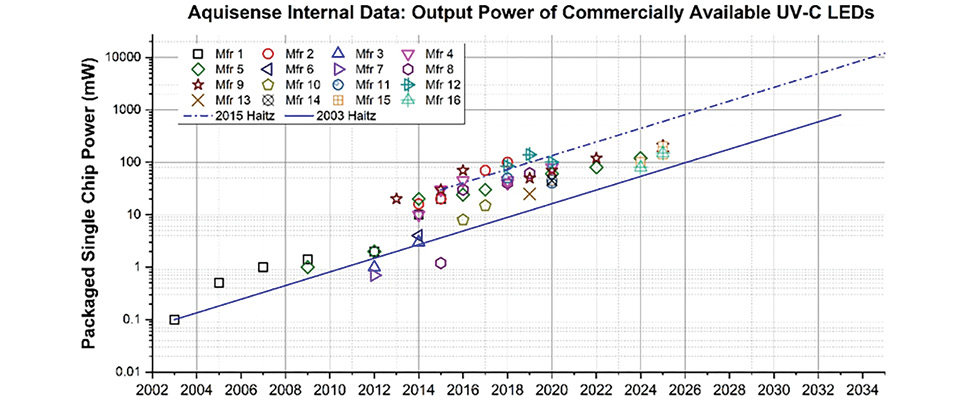
Increased regulatory pressure to eliminate mercury under frameworks such as the RoHS Directive and the Minamata Convention on Mercury is accelerating adoption in larger flow UVC LED systems. The transition is not being driven by regulation alone but also by performance, reliability and system level efficiency requirements for real world POE and industrial deployment. UVC LED development has followed Haitz’s Law, a predictable trajectory where the ability to generate photons increases 20-fold per decade while the cost decreases by a factor of 10.
As the performance of a single chip improves, understanding how this impacts the total system allows for a more sophisticated understanding of how this technology can not only address larger flow systems but also solve other system design limitations precluded by mercury lamps.
Light Sources in System Design
A persistent misconception in the market is that the performance of a single discrete UVC LED must match or exceed the light output and wall-plug efficiency (WPE) of mercury lamps to be viable. Based on these factors alone, mercury lamps have long appeared to hold an advantage. However, in reality, systems use an array of LEDs rather than a single diode; thus, this comparison is both technically invalid and operationally irrelevant.
In practice, large capacity UV systems employ multiple light sources in their design, regardless of the platform. Mercury lamps are deployed in banks; LEDs are deployed in arrays. Solid state devices like UVC LEDs scale linearly, predictably and densely.
Commercial UVC LED arrays delivering tens and hundreds of watts or more of optical output are already deployed in water treatment applications. Power density alone often favors LEDs, with arrays achieving higher UV output per unit area than comparable mercury lamps. This allows more compact reactor designs, shorter optical paths and improved integration into skid mounted or space constrained installations.
The Impact of Wavelength & Instant On/Off on System Efficiency
But what about the WPE for these arrays when compared to lamps? The historical use of low-pressure lamps has used 254 nanometers (nm) as the key germicidal wavelength. Research has shown that light sources that emit closer to the peak absorption of target organisms (265-270 nm) are a more effective UV source for disinfection applications.
UVC LEDs can be manufactured to emit in this optimal range, thus when attempting an apples-to-apples light source comparison, photons from an LED with 265-270 nm peak are up to 30% more efficient at inactivating a microbe than those from a low-pressure mercury vapor lamp. As a result, fewer photons are required to achieve a comparable disinfection effect. This directly impacts interpretation of the lamp WPE.
LEDs reach full output instantaneously and are unaffected by frequent on/off cycling. As a result, LED based systems can operate strictly on demand, aligning energy consumption with actual flow rather than installed capacity.
Field data from deployed systems demonstrates that POE installations often operate at duty cycles of less than 10%. When evaluated at the system level rather than the component level, UVC LED reactors routinely deliver dramatic reductions in total energy consumption.
In short, operational efficiency for the system—not light source output or WPE—is now the decisive metric, and UVC LEDs excel here. UVC LED based systems deliver targeted germicidal performance, on demand operation and long service life without the environmental burden of mercury. By shifting the conversation from lamp efficiency to system performance—and from legacy familiarity to sustainability—the water industry can modernize UV disinfection in ways that benefit operators, end users and the environment alike.
On-Demand Operation & Maintenance Cycles
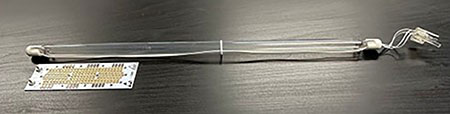
Maintenance requirements are where UVC LED systems most clearly separate themselves from mercury based designs. Legacy UV lamps are consumables. Their output degrades steadily, replacement intervals are tied to calendar time rather than actual usage and servicing requires handling fragile, mercury containing components. In industrial environments, this translates into predictable downtime and ongoing operating expense.
LEDs, by contrast, age primarily as a function of operating hours. They produce full power near instantaneously and suffer no penalty for power cycling. This allows UVC LED-based systems to operate in a standby mode for most of the time, instantly power up to treat water on demand and rapidly return to standby. In on demand systems, this converts directly into multiyear service intervals. The absence of fragile quartz envelopes and mercury contamination risk further simplifies service procedures and reduces the risk of unplanned maintenance.
When capital, energy, maintenance and disposal costs are evaluated together, total cost of ownership for UVC LED systems is now competitive with mercury based alternatives, particularly in POE and light to moderate industrial duty cycles.
Foundation for Future Innovation
Every technology transition in water treatment has been driven by the same question: Can we do this better without compromising safety?
POE water treatment is the next application segment poised to shift to UVC LEDs where flow rates are modest, UV transmittance is typically high and space constraints favor compact designs. Industrial water treatment spans a wide range of flows, water qualities and process requirements, but many applications align well with current UVC LED capabilities.
As RoHS exemptions tighten and sustainability expectations rise, the question for system designers and operators is no longer if the transition will occur but whether it will be proactive or forced. For many POE and industrial applications, mercury based UV lamps are no longer the only viable option. Transitioning requires recognizing that UVC LED technology has matured and that the industry is ready to move with it.
For more on disinfection, visit pumpsandsystems.com/tags/disinfection.