


Pulp and paper mills require some of the most demanding pumping applications in industrial manufacturing, often within facilities built decades ago. Across North America, many mills were constructed or last significantly upgraded in the mid-1960s or 1970s, and much of the original rotating equipment remains in service today. While the industry continues to evolve, investment priorities have shifted away from large-scale expansions toward improving the performance, efficiency and reliability of existing assets.
At the same time, mills face constant pressure to manage energy costs, minimize downtime and extend equipment life—all challenges that are compounded by aging infrastructure. To cost-effectively address this issue, targeted system-level upgrades have become a practical alternative to a complete plant replacement. Modernizing pump and motor systems, particularly in high-duty applications, serves as a way to achieve measurable gains without disrupting operations.
Legacy Infrastructure & Incremental Improvement
Despite advances in pump and motor technology, many applications, including pulp and paper manufacturing, continue to rely on fixed-speed motors and valve-based flow control. These systems were originally designed for reliability and simplicity, but they often operate inefficiently by today’s standards. Replacing entire systems is rarely feasible due to cost, risk and operational constraints. Incremental improvement has therefore become the dominant strategy, focusing on upgrades that fit within existing layouts and systems.
A System-Level View of Performance
In pulp and paper applications, inefficiencies are rarely confined to a single component. Performance losses tend to occur at the system level, where pump hydraulics, operating point and motor control intersect. Pumps that operate far from their best efficiency point consume more energy and experience increased mechanical stress, leading to higher maintenance demands, and costs, over time.
Valve-based flow control increases these challenges. Running a pump at full speed while throttling flow downstream wastes energy and accelerates wear, similar to operating a car with one foot on the gas and the other on the brake. Improving system performance requires aligning pump selection with actual process conditions and pairing it with motor control strategies that enable flow to be adjusted efficiently.
This system-level perspective increasingly shapes how mills evaluate upgrades to pumps and motors. Rather than focusing solely on individual components, engineers are assessing how pumps and motors perform together under real operating conditions and over long operating cycles.
Chemical Recovery as a Focus Area
Chemical recovery remains one of the most energy-intensive and maintenance-critical areas of a pulp and paper mill, and it also presents an opportunity for system optimization. Black liquor, white liquor and green liquor processes rely on multiple pumps operating continuously in abrasive, corrosive environments.
In many recovery boilers, dozens of pumps feed liquor guns around the furnace to maintain stable combustion and proper smelt bed conditions. Many of these systems were designed long before modern variable-speed control was widely adopted, leaving opportunities for improvement. Retrofitting existing pump installations with updated motor control solutions can reduce energy consumption and mechanical stress without changing the underlying process.
Because chemical recovery systems are central to mill operation, even incremental improvements in efficiency and reliability can have a meaningful impact on operating costs and uptime.
Pump Design for Harsh Pulp & Paper Service
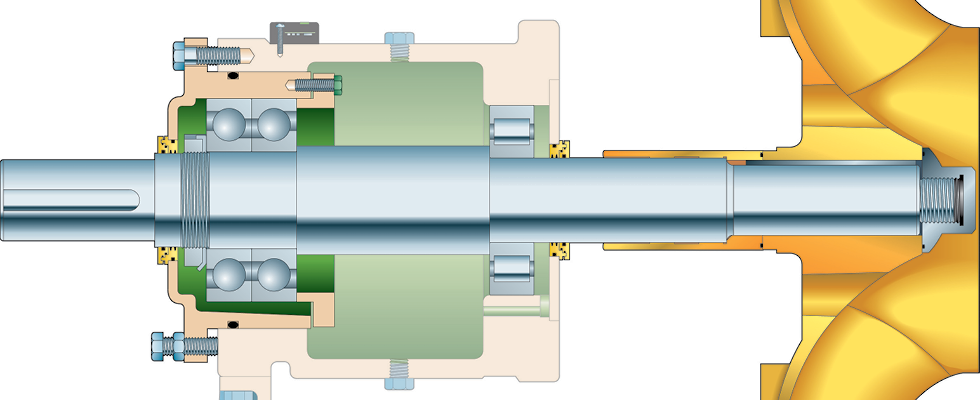
Beyond chemical recovery, pulp and paper mills rely on a wide range of pump types across stock preparation, paper machine approach flow, fan pump service, utilities and wastewater handling. Paper stock pumps must manage varying consistencies while maintaining stable flow, fan pumps must operate at high flow rates where hydraulic balance and bearing life are critical and process pumps must withstand corrosive chemicals and elevated temperatures.
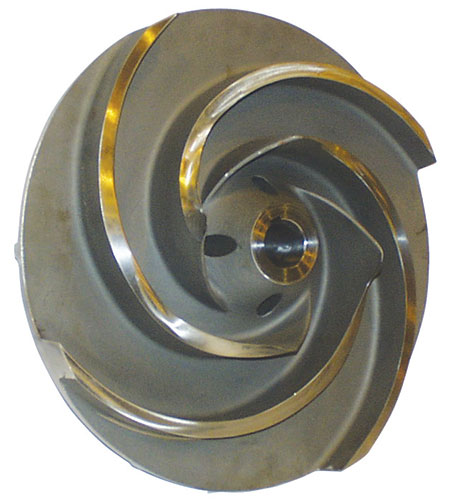
Pumps used in pulp and paper applications must handle fibrous, abrasive media while maintaining reliable performance over long operating cycles. Open impeller designs are widely used to accommodate solids and reduce clogging, particularly in stock preparation and recovery applications. Equally important is the ability to maintain efficiency as wear occurs.
As pumps handle abrasive fluids, internal clearances naturally increase, reducing performance over time. Designs that incorporate adjustable wear components enable these clearances to be restored without replacing the entire casing. This approach supports sustained efficiency while reducing maintenance time and cost.
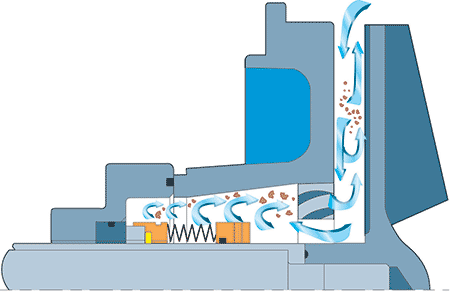
In abrasive pulp and paper applications, seal environment management is a critical but often overlooked factor in pump reliability. Fibrous solids, entrained air and vapor can migrate toward the mechanical seal, increasing wear, heat generation and the risk of premature failure. Modern seal chamber and bore designs address these challenges by actively managing internal flow paths rather than relying solely on external flush systems.
Advanced internal bore geometries use hydraulic features to direct solids away from the seal faces while minimizing debris entering the seal chamber. Continuous internal circulation helps remove air and vapor from the bore, stabilizing the seal environment across a wide range of operating conditions and extending seal and pump life. Designs that incorporate renewable, precision-fit wear components further support long-term performance by allowing internal clearances to be restored during routine maintenance without disturbing the casing or piping.
In some applications, seal chamber designs can operate with reduced or eliminated flush water, even at higher stock consistencies. Eliminating flush water lowers operating costs, avoids product dilution and removes common failure points associated with plugging or inadvertent valve closure. When combined with robust seal face materials and controlled internal circulation, these design approaches improve reliability while supporting longer operating cycles in demanding mill environments.
Across pulp and paper applications, consistency and maintainability are as important as peak efficiency. Pump designs offered by manufacturers emphasize broad hydraulic coverage, standardized components and interchangeable wear parts to simplify maintenance practices and reduce spare parts inventories. This approach supports long-term reliability in facilities where equipment must adapt to changing production demands without frequent replacement.
Improving Efficiency Through Modern Motor Control
While pump design determines how well a pump handles process conditions, motor control often determines how efficiently it operates day to day. Variable-speed operation allows flow to be adjusted to match demand rather than relying on throttling valves to restrict output.
Traditional variable frequency drive installations can require separate control rooms and long cable runs, adding complexity and infrastructure costs. Integrated motor-drive approaches reduce these requirements by placing variable speed capability directly at the motor.
In many mills, opportunities for improvement lie not in replacing pumps, but in rethinking how existing assets are controlled. Integrated motor solutions are designed with retrofit applications in mind, particularly in horsepower ranges that represent a large portion of the installed base. These systems are often applied where variable speed control has historically not been used due to space constraints or infrastructure limitations.
By simplifying deployment and reducing the footprint required for variable speed operation, integrated motor-drive solutions make it easier to modernize legacy systems incrementally. This allows mills to target specific processes, validate performance improvements and expand upgrades over time as budgets and operating conditions allow.
Targeted Modernization for Measurable Results
Not every pump in a pulp and paper mill requires modernization. The most effective upgrades focus on applications with high runtime, variable demand and significant energy consumption. Identifying fixed-speed systems that rely on throttling valves often reveals opportunities for improvement.
In many cases, pairing proven pump designs with updated motor control delivers a lower-risk path to improved performance. This approach allows mills to modernize selectively, improve efficiency and extend equipment life while staying within practical budget and operational constraints.
A Practical Path Forward
As pulp and paper mills continue to balance aging infrastructure with modern performance expectations, targeted pump and motor system upgrades offer a practical way forward. By evaluating performance at the system level and focusing on high-impact applications such as chemical recovery, mills can improve efficiency, reliability and life cycle cost without major capital projects.
For mature facilities, incremental modernization remains one of the most effective strategies for sustaining long-term performance. Thoughtful integration of robust pump designs and modern motor control technologies enables mills to address today’s operational challenges while preparing for the demands of the future.
For more on pulp and paper, visit pumpsandsystems.com/tags/pulp-paper.