

Operators know the pattern well: A quiet night, a routine status check from the control room and then suddenly an alert for a clogged pump. The telemetry data suggested normal operating conditions just moments before, but the midnight maintenance visit reveals a different story.
While such failures can appear sudden to the operations team, the reality is often quite different. In many cases, the failure was not sudden at all, but rather began as a faint, almost imperceptible change in the pump’s behavior—long before any supervisory control and data acquisition (SCADA) system flagged trouble.
This situation reflects a fundamental problem facing modern water utilities—not an absence of data (utilities are drowning in data), but rather the absence of visibility into the data that can most reliably signal upcoming failures.
This challenge is particularly acute in wastewater monitoring, where accessibility is a constant logistical hurdle. It is nearly impossible to install sensors on assets like submerged wastewater pumps and remote lift stations, complicating routine maintenance and blinding operators to the true condition of their assets.
The Limitations of Legacy Approaches
In the past, the industry’s response to these blind spots has been to conduct more physical inspections and preventative maintenance. However, more inspections cannot continue to be the answer. They require costly pump lifts and place further strain on maintenance teams who are already stretched thin by a shrinking workforce and the loss of expertise. Each lift adds labor hours, increases safety risks and generates excess emissions, all with no guarantee that early-stage degradation will be found.
Utility companies therefore increasingly rely on data to avoid urgent wake-up calls. Remotely collected telemetry data have been, and remain, at the heart of modern wastewater operations. Utilities depend on SCADA systems (which in turn rely on telemetry data) as well as remote sensors to track water levels, pressure, flow and pump performance across distributed networks in real time. This provides a constant stream of operational data that enables day-to-day control of the system.
However, there is a critical distinction between operational data and health data. Telemetry is designed to show how the system is behaving right now, not to anticipate an upcoming failure. It only captures developing faults once they have become severe enough to influence macroscopic performance.
Sampling Method Shortcomings
Why do these faults go undetected for so long? The answer lies in how data is collected. Telemetry relies on sampling infrequently (every few seconds to minutes) and using root mean square (RMS) averaging. It therefore captures the overall picture but misses high-frequency details that reflect the beginning of degradation and blockages.
Take, for example, electrical data from a pump. The earliest signs of wear appear as tiny distortions in the electrical signal. Telemetry’s low sampling rates and RMS averaging strip out this nuance. By the time a value rises enough to notice, the underlying fault has been developing for a while.
Low sampling rates introduce a further limitation that traditional methods cannot overcome. The higher frequencies, where early signs of mechanical and hydraulic faults show up, simply fall outside what telemetry records. If they are not captured in the first place, no amount of averaging or trending can reveal that a fault is starting to form.
These sampling limitations mean that the earliest indicators of wear are lost before they ever reach an operator’s screen. The result is a structural blind spot in a utility’s monitoring capability.
The Economic Impact of Blind Spots
The economic consequences of these blind spots are significant. Pollution events are accompanied by cleanup costs as well as broader downstream impacts, including reputational damage, user complaints and unplanned network disruptions. In the U.K., the costs of cleanup and regulatory penalties stemming from sewage spills can drain water utilities of up to 10% of annual revenue.
Beyond the catastrophic cost of spills, the routine practice of pump lifts represents a substantial operational burden. Labor, transport, confined-space entry procedures and associated emissions all add up. Even modest reductions in unnecessary lifts create meaningful savings.
With infrastructure aging and many experts approaching the retirement age, the stakes are higher than ever. As utilities shift their focus from upfront capital costs to the full cost of operating and maintaining assets, the pressure to optimize maintenance continues to grow, and relying on reactive data to avoid pollution events is no longer a sustainable practice.
Bringing the Invisible to Light

This is where electrical signature analysis (ESA) comes in, bringing a new type of data—and new operational possibilities—to the table. ESA relies on high-frequency current and voltage data from assets. It monitors the electrical heartbeat of critical equipment, millisecond by millisecond. Using advanced analytical techniques, ESA is able to link subtle changes in current and voltage to developing faults—magnetic flux disturbances from bearing wear, low-frequency loading signatures from a tightening impeller—long before breakdowns occur.
The “No-Touch” Advantage
ESA analyzes data directly from the motor control cabinet. This makes it ideally suited for assets in inaccessible environments. Such assets are commonplace in the water industry. For pumps that are submerged or in Atmospheres Explosible (ATEX) zones, installing and maintaining traditional monitoring tools like vibration or pressure sensors can be difficult and expensive and as a result in some cases these assets have been allowed to run until they fail. ESA can avoid these challenges by gathering its data far from the wet well. It is able to detect mechanical, electrical and hydraulic faults without ever touching the asset—a “no-touch” solution to what has always been a “high-touch” problem.
ESA in Action
The technology is already proving its worth in the field. For example, Yorkshire Water has been able to prevent spills and significantly reduce site visits by using ESA-based monitoring. In one notable incident, SCADA reported a healthy pump, but ESA detected an electrical signature characteristic of an inlet blockage. An alert was sent and a crew was dispatched to inspect and ultimately clear the pump, avoiding a pump lift and £24,000 in costs.
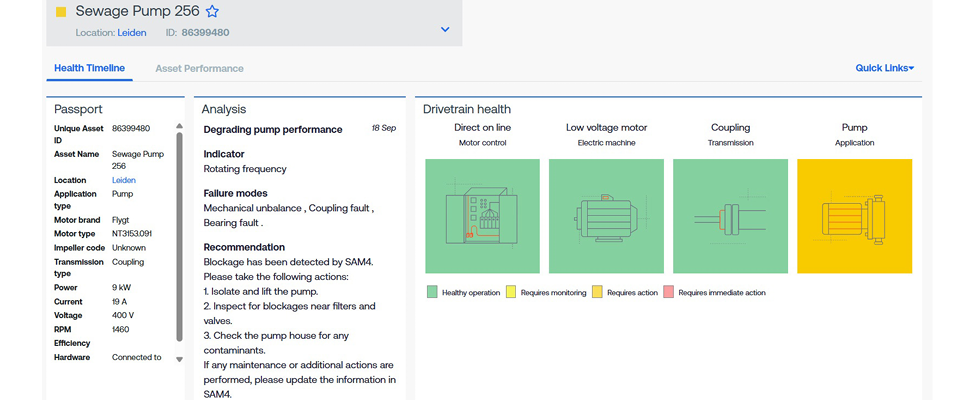
When ESA-based monitoring was trialed at Southern Water, meanwhile, it detected 63 developing failures on submersible sewage pumps and other key assets across their network. This helped avoid £5 million in potential equipment damage and penalties. Now deployed at a growing number of water utilities, ESA-based monitoring is helping reduce emergency responses, prevent pollution events, eliminate unnecessary pump lifts and build more resilient water networks in the U.K. and beyond.
From Firefighting to Peace of Mind
Utilities using ESA report a noticeable shift in day-to-day operations. Instead of scheduling pump lifts at fixed intervals or reacting frantically to alarms, maintenance teams are able to review fault signatures, assess urgency and coordinate interventions before performance declines or spills occur. The result is a more predictable workflow and fewer surprises.
In the end, reliability depends on visibility. Telemetry remains an essential tool, but it can only show how pumps are performing right now. ESA closes the visibility gap by anticipating emerging problems. Together, telemetry and ESA provide true situational awareness for complex, distributed pump networks, giving operators the ability to manage both their assets and their network with greater confidence and peace of mind.